


Catch Them When You Can: Uncovering Golden Cultural Opportunities Amidst Travel Warnings
On a recent trip to several less-visited countries, the woman who I roomed with said, "I just don't know where to get my Instagram photos here." There were plenty of scenes to snap, but far less trending direction to go from previous vacationers, no frames, platforms, or overly-landscaped vistas to congregate toward. Her Insta photos were quite distinct from those of travel influencers – in the end she did pretty well, capturing oddly architectured villages, smiling kids carrying their siblings on their backs, and cultural talismans.

In today's globalized world, bringing home a truly distinct cultural experience from a trip is increasingly rare. We prize mimickery of influencer's online spaces from Barcelona, Bali, or Marrakesh; or choose destinations from the reliable experiences of friends and family from places like Cancun, Toyko, or Santorini; or pick travel where the annual trends direct us like to Florence, Machu Picchu, or Puerto Rico – long before dropping in on the lesser-known destinations of Iraq, Benin, or Bhutan.
For tourists, the great popular getaways offer cultural escapism from the mundane life at home within comfortable expectations – and they also showcase deep history, curious geography, and bygone tales through art and architecture once you dig further than your accommodation.
But ... because a lot of people visit these places, they are also more tailored for the tourists and their expectations. I'm suggesting that, in addition to the frequently-visited locations, there is also something deeply edifying about spending moments in places that don't make it to viral vacation videos or "Top 10" listicles.
Traveling to Tripoli for Eid al Adha
I could highlight several phenomenal destinations to illustrate this, but fairly recently, I uncovered a golden opportunity for cultural travel in Libya. At the time of travel (June 2024), the Country was experiencing a ceasefire for two years from their civil war and any escalation was expected to start on a front far from our itinerary's destinations. Tourists were not a target in this conflict, but our visas were only valid for the Western part of the country – the East would not recognize our credentials.
I travelled with three others during the Muslim holiday of Eid al Adha; Yazid, Olga, and Amanda. This holiday honors Ibrahim's willingness to sacrifice his son (a story known to Christian's in the Bible where the main characters are "Abraham" and "Isaac") – in Islam, the son on the alter was Ismael – who is a Muslim prophet and the forefather of the Prophet Mohammed, the founder of Islam. Sheep or goats are the celebratory dinner of choice, since Allah sent this animal to replace Ismael as a sacrifice.
Dried sheep intestines are a delicacy. Sheep waiting for Eid al Adha in a walkway near a family's home in Tripoli, Libya. Sheep being brought to a family's home in Tripoli, Libya. A sheep hanging from a ladder in preparation for the Eid al Adha Feast in Tripoli, Libya.
This story, connected to Eid al Adha, is notable because during our first two days in Libya, we saw sheep in every stage of life and sacrifice; from bleating and being herded from pastures, sold, tugged down cobblestone streets in Tripoli, jugulars slit on the side of the road, skinned and hanging to drain blood for dinner preparation, roasted over a fire for the traditional meal, and in piles of wool on the roadside for disposal collection. We even saw a woman hanging the intestines out to dry for the traditional Libyan Ousban (recipe here). There was no tourist rerouting to avoid the unsavory parts of this tradition that everyone in the country participates in. While at times it was uncomfortable, it was a view into this holiday and the traditional practices that Muslims still live by in Libya – Halal practices that have been industrialized or happen behind closed doors in other Muslim countries where I've been in during this holiday.
On our journey, a member of the Tourist Police accompanied us everywhere. He only spoke a few words of English, but was happy that I tested my Arabic with him. I learned the word, "harouf" (خروف), which means sheep or lamb and he laughed every time I also put a new adjective with it.
خروف جميل - pretty sheep - harouf jameel
big sheep - harouf kabir - خروف كبير
brown sheep - harouf buni - خروف بني
The day after the big Eid feast, we drove out of Tripoli and I spotted a flock sheep on a hillside and said, "there are the survivors." Our English-speaking guide translated this to the Tourist Police and he burst out laughing. Arabic and the sheep were a good and human connecting point.
Tripoli
Despite the quiet nature of Tripoli during a holiday weekend, we were able to enjoy an afternoon coffee, stroll the streets, and the mostly-closed market, take our time at the Arch of Marcus Aurelius, and linger at the Red Castle (Alsryah Alhmra) and adjacent Martyr's Square. Reflecting on the architecture while I gathered my photos for this post, I noticed the prolific use of arches across the country – from entry monuments, to arched walkway, windows, doors, and artwork. It's a prominent design feature.
Tuckered out from a long flight and the hot day; and tucked away at our hotel for the night, we gathered for a quiet dinner amongst the four of us. Despite the vast number of sheep and goats on the dinner table, our Eid feast was takeout from the only open restaurant in Tripoli. We had pizza in our hotel's empty buffet restaurant that our guide, Abdul Rahman, had generously driven around for an hour to find. Despite the challenging food experience, I appreciated that everything closes so people can take time to spend with their families for this important holiday.
Arch of Marcus Aurelius in Tripoli, Libya with mosque in the background.
Leptis Magna
To me, Leptis Magna sounds like a mythical civilization in a far off universe; especially when I learned that Septimius Severus was the very "other-worldly" Latin-sounding and ominously-named Roman Emporer responsible for the city's significant buildout between 193 - 211 AD. In fact, the community was first inhabited by the Punic people (also known as Phonecians). It was part of the Carthigian Empire before the Romans came upon it in 111 BC. After some time as a free community under Roman Rule (when it's said that up to three million pounds of olive oil was paid to Julius Ceasar annually) Leptis Magna became part of the Roman Empire under Tiberius. It was a remarkably beautiful and influential Roman city. Nero built a tremendous amphitheater, similar to, but smaller than the barbaric Colosseum in Rome, overlooking the Mediterranean Sea –and a bishop from the community, Victor, eventually became a Catholic Pope.

When Septimius Severus took over, the city was thriving and he anchored Leptis Magna's importance on the Mediterranean Sea routes and Saharan trade routes. This lasted until the third century when the Roman Empire was severely compromised and trading fell. Leptis Magna was taken by the Vandal Kingdom who "vandalized" the City walls (yes, the term comes from the people) and sustained damage by the Amazigh attack (more commonly, but less preferably called the Berbers). The Byzantines conquered it back for the Roman Empire, but eventually abandoned it before the Islamic conquest took the City. By then, the population had diminished and it was covered in sand. What has been recovered today as an UNESCO Heritage Site at Leptis Magna may only be a third of what remains buried in time.

Hospitality in Ruins
One of the grandest illustrations of hospitality in Libya was our experience arriving at Leptis Magna. Our day started out late so that our guides and drivers could spend time with their families on the first day of Eid. We drove just under two hours from Tripoli, along the Mediterranean Coast, to Leptis Magna. It was officially closed for the holiday. But, hearing that some foreign travelers were in town, we were met with a group of men curious to open and secure the site for our visit. What an absolute pleasure to be warmly welcomed and ushered into the site; just around 10 of us in all for a half day exploration and tour.
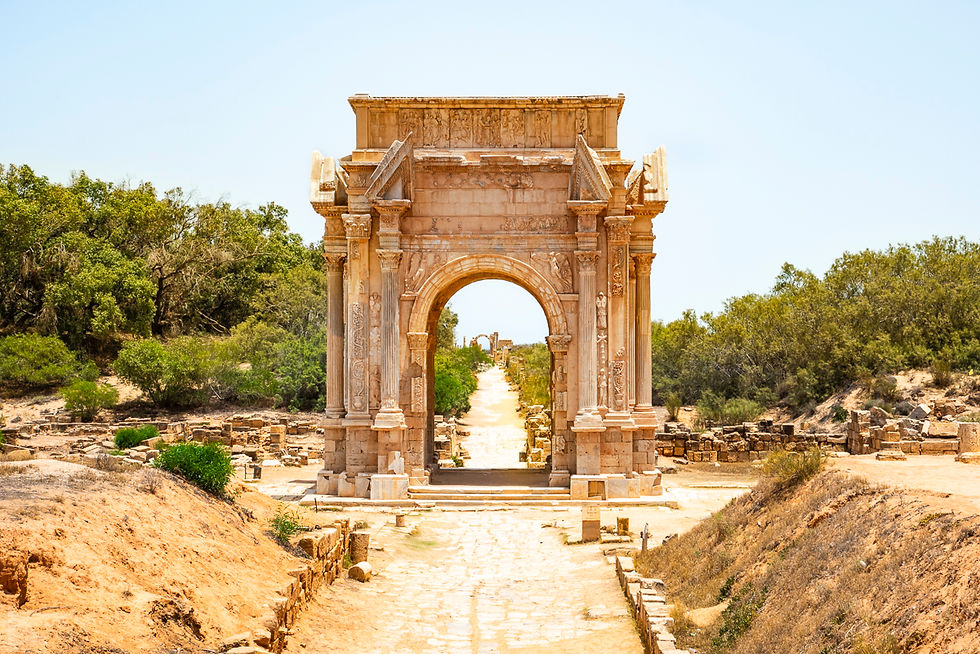
Walking through the marvelous marble Septimius Severus Arch and into this empty and beautifully excavated and preserved city felt surreal. We spent hours learning the history and then imagining what life would be like to take a few laps at the Palaestra and then frequent the adjacent Hadrianic Bath with cold, warm, and hot pools – and something akin to modern, albeit quite public, toilets where we could catch up on the latest Leptis gossip – and then off to the market where weights and measures are still etched in stone cylinders for oil and grains and by ethnic size of feet and arms that indicate the breadth of geography people traded from in the span of a Greco-Roman foot, an Alexandrian (Egyptian) cubit, or Punic (Phoenician) arm. We walked in the lanes of chariots, donkey carts, common people, and emperors. And we took a short drive to the nearby colosseum, still somewhat filled in with sand, where animals and humans were pitted against each other in brutal shows of human indignation; like those in the Roman colosseum.

A personal highlight was in the theater, built between the first and second centuries. This is where I garnered a bit of courage to sing "Amazing Grace" from the stage for our small group and the birds listening. The acoustics still work when you stand in the right places against the cascading seats.
The structural integrity and scope of the site at the Leptis Magna ruins will ruin other Roman ruins for the rest of your life. If only the stones could tell us more stories! We departed sunkissed and returned to Tripoli after a long day to rest for a drive south the next morning.
Ghadamès, an Ancient Oasis
If you would have told me to build a town as a child, I would have built a maze of homes where all my friends could play and see each other at a moment's notice. This is what Ghadamès was – and to some extent, still is today. The last resident, a woman, left her home in this ancient Saharan village in 1982. But the history of this oasis town may go back 6,000 years or more; making it one of the oldest known pre-Saharan settlements. Written records about Ghadamès start in the first century BC with the Roman Empire establishing a presence in this trade center in the desert.
There are some impressive features to this town. Most notably, the streets have covered pedestrian walkways on the ground level. During hot summer days when the temperature can reach more than 41°C (105°F), these walkways could stay much cooler. Men from the community still use the benches and corners of these streets to gather with a tea, coffee, or a smoke. On our tour, we sat for an almond tea at a small cafe. A man dressed in colorful clothes, in an equally colorful teashop, frothed our tea by pouring it back and forth to aerate it sufficiently before pouring it over almonds.
Making almond tea in Ghadamès, Libya. Making almond tea in Ghadamès, Libya. Making almond tea in Ghadamès, Libya.
While men socialized at ground level, women's free space was on the rooftops. In a society where women were not meant to be seen by men without proper head coverings, they could covertly cook, congregate, and move between every home in the town by rooftops paths. I enjoyed trying out a few routes before the June sunshine had me seeking some shade!

Inside these homes, a bride would bring everything she needed to beautify and make her household run smoothly. The ground floor was typically used for storing goods and possibly animals, the first floor was dedicated to living spaces, and the upper floor was where cooking and socializing amongst women took place. We had the extraordinary opportunity to eat a traditional meal inside a home after we descended from the rooftops.

Ghadamès, nicknamed the "Pearl of Africa" was populated by the Amazigh people. This people includes historically settled and a few nomadic Saharan ethnic groups across North Africa. Their lineage can be traced back to 2000 BC and they share a mother tongue with many dialects. Although the area was "Arabized" in the 7th century, many still keep their language and remain proud of their heritage.
An outdoor pathway framed by palm trees in Ghadamès in Libya. A covered walkway in Ghadamès in Libya. A covered area in Ghadamès in Libya. One of the mosques inside Ghadamès, Libya. A view of Ghadamès, Libya from the outside. The outside of the Ghadamès, Libya.
It's not surprising that this people of the Sahara would congregate around the lush oasis at Ghadamès and find ways to sustainably build and insulate their town against the heat. The old way of building still has a superior cooling effect to more modern and energy-intensive construction.
Sand dunes overlooking the Sahara and Libyan border with Algeria. A license plate on the front of a Land Cruser in the foreground reading "Libya" in Arabic. A Toureg man stands a disk of bread on its side in the sand in the Libyan Sahara desert.
On our last night in Ghadamès, we spent an evening in the desert, marveling at the sand dunes on the border with Algeria, and enjoying bread baked in the sand by several Toureg men. It reminded me of a similar experience a couple years earlier, gazing across the sand dunes from Algeria toward the border with Libya.
Places I never knew existed...
On our journey across northwestern Libya we visited a few places that surprised me more than others – and in every instance we were warmly welcomed and spent time as the only tourists at the sites.
The first was Qasr Al-Hajj. The name means "Pilgrim's Palace" and as such, it was a resting and meeting place for Muslims on their Hajj to Makkah.

What we encountered was not a palace, but a stone and mud structure that was built to store grains and olive oil in the same way we might use a bank deposit box. It has 114 rooms; some of which still contain pottery and remnants of items stored here as recently as the 1960's. We walked the slender ledge to the top floor and followed the peremeter familiarizing ourselves with the peculiar shape and clever storage system.
We visited two similar commodity depositories on our way to and from Ghadamès.
Qasr Kabaw is less identifiable than Qasr Al-Hajj from the outside, but once inside it opens into a similar round uncovered courtyard with about 360 openings to storage spaces that rise up six stories. The structure wasn't as safe to climb around, but we were able to explore a lower level tunnel for some cheeky version of hide-and-seek amongst adults.

Nearby, we also saw an old olive press that is out of use today but still kept in working order. It was constructed below ground where the temperatures are cooler and more regulated. The first step of the process requires crushing olives under a massive stone. While I was able to wiggle the stone on its pedestal, it was heavy and locked in place, so my olive pressing was limited to a couple centimeters.
After the actual olive press operators crushed the olives, the mashed mess was placed between mats traditionally made from woven palm fronds. Weights pressed them together, slowly extracting the oil that seeped out the sides into culverts that allowed the oil flow into vessels carved into the floor. From these containers, it was scooped up and put into bottles for sale or use by the farmer. A portion was left as payment for the olive press owner. In this press, the weight came from a large and heavy palm trunk that is cantilevered over the stacked mats full of crushed olives.

Qasr Al-Nalut might be the craziest-looking, or most palatial, of all three granaries that we visited. It reminded me of drip castles I used create on the beach. Rather than a large open stadium setting, we we entered the facility and stepped down sandy pathways flanked by the storage rooms on the outside and inside walls.
The granary of Qasr Al-Nalut in Libya. Abdul Rahman walking through Qasr Al-Nalut in Libya. A close up of the windows and mud structured storage facility at Qasr Al-Nalut in Libya.
Nalut is about half way from Tripoli to Ghadamès and was a nice resting spot for us, as it must have been for travellers and pilgrims from 1312 (a year inscribed on the local mosque) who also wanted a break. In addition to the commodities stored here, there is some evidence that families in the communities also stored valuables and documents in these spaces.

The last curious place I'll explore here also feels like the last place in the world. Termisa (incredible video linked) is a vacated village that seems to stand on the end of the world – at the "terminus." The strategic location actually enabled inhabitants to see enemies or allies approaching with an upper hand – either to pelt them with ammunition or get the food ready for their travel-weary friends. The place is beautiful and the ruins of the town are just enough to imagine what beautiful views residents enjoyed in this close community. We definitely felt every bit of being on the "edge" while we explored this place.
"Oh the Places You'll Go..."
When booking a destination, it's easy to follow trends and the experiences of others – and then be part of a common experience from that place. This is part of how we build community with our families, friends, and neighbors. But also consider that as vacationers descend en-masse on a popular destination, it changes that experience as well. When hundreds, or even thousands of people flock in, the focus turns to catering to the visitors by selling t-shirts, and shot glasses, and streamlining tours to attract more tourists and their money. For those who take the roads less traveled, you'll often find, untouched landscapes, empty UNESCO and historic sites, and genuine warmth from people who are excited to share their culture and stories.
If taking in authentic culture is more your style – or something you would like to try, consider that when a travel warning is set for a country, perhaps this, with some worldly and wise discernment, it's the best time to venture out and explore these countries that are less prepared for the masses and are more enthusiastic to see just you.
A final lesson can be taken from this trip as well: When you're curious to visit a place that has been closed off to foreigners, just GO when you have the chance. There has been some notable sad events in Tripoli while I was drafting this post that may create some challenges for obtaining tourist visas right now. But watch this destination. Libya is rich in cultural heritage, history – both ancient and modern, and was easy to navigate with a trusted local guide.
------
Explore more about this extraordinary country through the links in this article or below!
YouTube: They no longer get tourists here (Ghadames, Libya), Authentic Traveling
Wikipedia: Ghadames
YouTube: Ghadames (Libya) Vacation Travel Video Guide, Expoza Travel
YouTube: Gordon Ramsay Learns The Medieval Way Of Making Olive Oil, Gordan Ramsay: Uncharted
YouTube: Libya's olive harvest: Small town continues centuries-old industry, Al Jazeera English
Wikipedia: Qasr Al-Hajj
The trip to Libya in June 2024 was booked through Trekkup Dubai. This blog is not sponsored.
*** #explore #wanderlust #InstaTravel #travel #WomenWhoTravel #TravelLove #CultureTrip #goOutside #JustGo #Libya #Tripoli #photography #color #travel #SheTravels #Asia #OffTheGrid #PrayForHumanity #AboveAllLove #explore #globaltravel #exploretheworld #curioustraveller #africa #AfricaTravel #RomanRuins #NorthAfrica #TravelStories #SeekingAdventure
© 2024-2025 Andrea Rip | The Earth Ink. All rights reserved.


Comments