


Tensility of Change in South Sudan
A palpable energy in South Sudan, the world's youngest country, can be felt in the busy market place in Juba. It is in the hopeful language of our tour guides and the vast number of migrants from surrounding countries who have arrived in the capital for opportunities – investing their work and hope in a new government. Even in a short November 2024 weekend visit, I felt a mix of awakening and angst as we navigated a blend of paved and dirt city streets in Juba. The population feels young, confident, and traditionally grounded with an awareness of their resources – those assets reflect the diversity of their geography including grasslands, savannahs, rainforests, and floodplains – and the human capital within the City. Juba is attracting immigrants from surrounding countries who see it as an opportunity for their own security and growth.
Clay pots for sale in the market in Juba. Ginger coffee made fresh at the market in Juba. Spices fill porcelain pots for sale at the market in Juba.
Photos from the market in Juba.
But this energy carries an err of tensility of change in South Sudan – enabled and impeded by the politics of the day. In a world of polarization, an astounding 98.8% supported independence for South Sudan ahead of 9 July 2011 when they officially gained sovereign statehood. That's not to say there isn't still unrest – because there is – along with a massive diaspora. Warring territories fought for representation in the new government in a civil war between 2013 to 2020. After my visit, further tensions developed in 2025 – as I draft this, opposing forces remain deadlocked (September 2026).
But, the difficult political news did not (then) deny the potential of this young country and the hope threaded between the wrinkles of conversations we heard to in South Sudan.
I was joined by Rohit and Amy on this weekend expedition to Juba and to meet the Mundari People – a traditional agrarian and photogenic group of people who live in symbiosis with their Ankole-Watusi cattle.
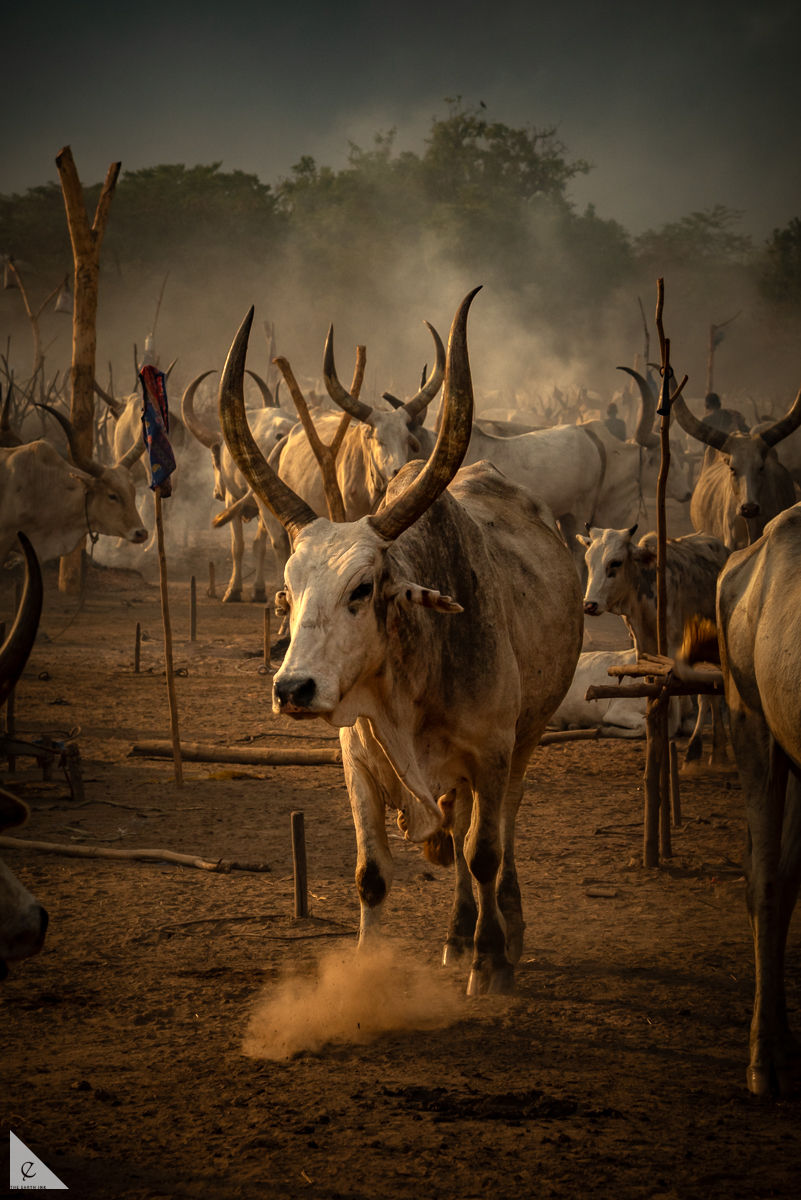
We spent an evening crisscrossing the Mundari camp as the men brought their cattle back from pastures. The camp itself was a vast dirt pad between trees and brush that hid the massive settlement. A few cots made of tree branches dotted the landscape with numerous pegs in the ground – each peg belonged to a head of cattle that intuitively turned up at their post every evening with little guidance (perhaps an occasional stray exception).
The first evening we spent with the Mundari, we we watched a thunderstorm approach and eventually engulf us in a massive rainstorm. Waterlogged, we ran for the trees and let it pass before continuing skipping over mud puddles as the water absorbed through the soil.

Besides the rains, the Mundari community welcomed us too kindly – allowing us to wander through the herd, ask questions through our guide, and pose for an infinite amount of photographs – too many beautiful portraits to share in one blog (so keep an eye on @theearthink on Instagram for more).
The cattle are some of the most indulged livestock I have seen. They are rubbed down with ash daily, some horns are adorned with tassels, they are guided to pastures and rivers for food every day and then back home to a familiar space free from bugs. In fact, the ash keeps bugs and bacteria from settling into the animal and human skin in the camp.

Every part of the cattle's existence is used to the benefit of the Mundari people. The excrement from the cattle is collected in all types of containers and collected in a pile. Not only does this keep the camp relatively free from dung, it allows it to dry before it is burned. The camp fires at night and into the morning keep mosquitoes and flies away while the ashes provide additional protection when applied to the skin – like soap to cleanse the body.
Cow dung is collected in containers and moved to centralized piles to dry for burning. The cow dung is burned down to ashes that has a side benefit of keeping the bugs away. A Mundari man rubs ashes into his cow's hide to clean the animal and keep bugs away, The ash from the cow dung fires is rubbed into the Mundari people's hair and skin for cleaning.
Click to expand and scroll through the carousel to see how cow dung is collected, burned, and applied to cows and people to keep clean in the Mundari camp.
Similarly, the milk and urine are also used. Each morning the cows are milked – either into a container, or straight into the mouth. Even the children know how to stimulate milk production – I’ll spare you the intimate details and those photos.
Besides rubbing ash into the body, the Mundari stay remarkably bacteria and parasite free with urine from the cattle. I was amazed that the boys we followed around could identify a bovine ready to pee – each time they either collected the urine in a pitcher or stood right in the stream. Other side affects from the uric acid in this type of bathing cause the hair to turn red or orange which is considered beautiful – and sometimes, the people's eyes also become red.
A young boy squirts milk straight from the cow into his mouth. Milking a cow into a blue plastic pitcher. Boys take turns pouring bovine urine over each other's heads. A young boy cleans his head under the stream of cow's urine.
Click to expand and scroll through the photos to see how cow's milk and urine are used in the Mundari Camp.
Part of the Mundari culture has included symbolic scarification – that is carving designs into their skin that leave a lasting ridge, a scar, in the skin. The most typical Mundari design is a downward-facing Chevron on their forehead.
A man with a chevron of scarification on this forehead looks straight at the camera. A scarified woman brushes her teeth.
I felt honored to arrive back at the camp before sunrise and be there as the people and the cattle woke. We became part of the camp for a short while – learning, chatting, photographing, and participating in the life or the people, cattle, and earth. Before we left another group of the Mundari people had been accepted to settle in this camp. Their entrance was our queue to leave one of the most fascinating communities I've visited.

Seeing the stark differences between my life in the UAE and this outdoor, agrarian lifestyle reinforced my belief that there is no one way to live a fulfilling and content life. I admire the sense of community and willingness to allow outsiders, like myself, Amy, and Rohit to experience that – to share a laugh, a conversation, and a morning. Digitalized societies are missing this tangible closeness to each other and the planet. While I was there, I couldn’t help thinking that from the outside, it’s easy to “other” the Mundari and similar groups of people who have such different ways of living and coexisting with animals and nature – but maybe it’s them who should marginalize the rest of us for pillaging the world of its resources so we can buy closets full of clothes on a whim and purchase the latest technology.
---
References and further reading:
Atlas of Humanity: Mundari Tribe, South Sudan (beautiful photos) Wikipedia: South Sudan
Africa Geographic: The Mundari of South Sudan
United Nations News: Sudan & South Sudan
This exploration of South Sudan was booked through Trekkup Dubai. This blog is not sponsored.
AI was not used to generate the text, images, or audio in this article.
*** #Juba #SouthSudan #MundariTribe #Tribe #Mundari #people #explore #wanderlust #travel #WomenWhoTravel #TravelLove #UNESCO #coloroftravel #CultureTrip #goOutside #JustGo #photography #color #travel #SheTravels #Africa #OffTheGrid #explore #globaltravel #exploretheworld #curioustraveller #travelphotography #everypassportstamp #offthebeatentrack #people #culture #community
© 2024-2026 Andrea Rip | The Earth Ink. All rights reserved.


Comments